History
Windsor history: a halfway house, a sugar factory, a tornado and a town that doubled
A stage stop halfway between Greeley and Fort Collins, a railroad in 1882, a beet factory that ran 60 years, Kodak on the same ground, the costliest tornado in Colorado's history, a mill burned and rebuilt, and a town of 18,644 that became 32,716 in a decade. The short history of Windsor, Colorado, with sources.
· Checked October 1, 2026
Windsor begins with a house halfway between two towns. In 1873 a settler named J. L. Hilton built a small house on the Overland Trail wagon road midway between Greeley and Fort Collins, and the Halfway House, as it became known, fed and slept travelers, stagecoaches and the mail. It is the oldest structure in town, and it still stands, restored since 2020 with the 1907 Dickey farmhouse as the Historic Halfway Homestead, the Town’s first designated landmark site. The turning point came in 1882, when the railroad connecting Greeley and Fort Collins laid its line through the wheat country, a depot went up, and the town was platted. The settlement took its name from the Rev. Samuel Asa Windsor, and incorporated in 1890. The 1882 depot survives too: it was moved a quarter of a mile from its original site and now sits in the Windsor History Museum on the lake shore, beside an 1885 schoolhouse hauled in from the county roads north-west of town.
The sugar town
Irrigation made the farms, and the farms made the factory. Telephone service arrived in 1893, and in 1903 a factory for turning sugar beets into sugar was built at Windsor; it became part of the Great Western Sugar Company in 1905, the year the Town’s own history dates the start of processing, and by 1919 it could slice 1,150 tons of beets a day. For more than half a century the factory was the town’s economy, worked in large part by the German-Russian immigrants who shaped the community of that era and whose beet shack, from south of Windsor Reservoir, is another of the museum’s buildings. Electricity came in 1909, the same year the town built its two-story Classical Revival town hall on 5th Street to the designs of Oscar R. and A. M. Felmlee, with the town’s offices, the police station and two jail cells inside, and the fire station and the town’s single fire truck on the lower level. The town had a hospital, an opera house and several schools in those years. Across the tracks, the flour mill that burned in 1899 was rebuilt the same year as the four-story Windsor Milling and Elevator Company and ground flour and feed until 1990.
The factory closed in the mid-1960s, in 1966 by the Town’s account and 1968 by Wikipedia’s list of Great Western plants, and the ground did not stay empty. Eastman Kodak took over the site in 1968, drawn by the water and the land, and the Kodak Colorado plant that followed employed generations of Windsor residents, at one time about 3,500 people. That era ended slowly. Carestream Health, the former Kodak medical-imaging unit sold off in 2007, closed its Windsor operation in 2024 with the loss of 236 jobs, leaving Kodak Alaris’s souvenir-photo business as the last Kodak name on the campus. A company called Global AI has since proposed a data center on the former Kodak and Carestream ground, which lies in unincorporated Weld County east of town; the Town has issued a will-serve letter for water and sewer and nothing more.
The tornado
At 11:26 on the morning of May 22, 2008, a tornado touched down south-east of Windsor and ran north-west for 24 miles over the next 42 minutes, at times 1,760 yards wide, with winds estimated at 165 mph. The National Weather Service rated it EF3, and the worst of the damage fell on the campground at Missile Silo Park and on the homes and businesses of eastern Windsor. One man was killed trying to drive his motor home out of a trailer park; 78 people were hurt; some 850 homes were damaged and nearly 300 were badly damaged or destroyed. Privately insured losses came to $147 million by the Weather Service’s count; Wikipedia’s later tally puts the damage at $193.5 million from about 24,000 claims. The 1909 town hall was damaged and restored that year; the old mill, which a previous owner had just spent more than $500,000 stabilizing, was struck too.
The mill
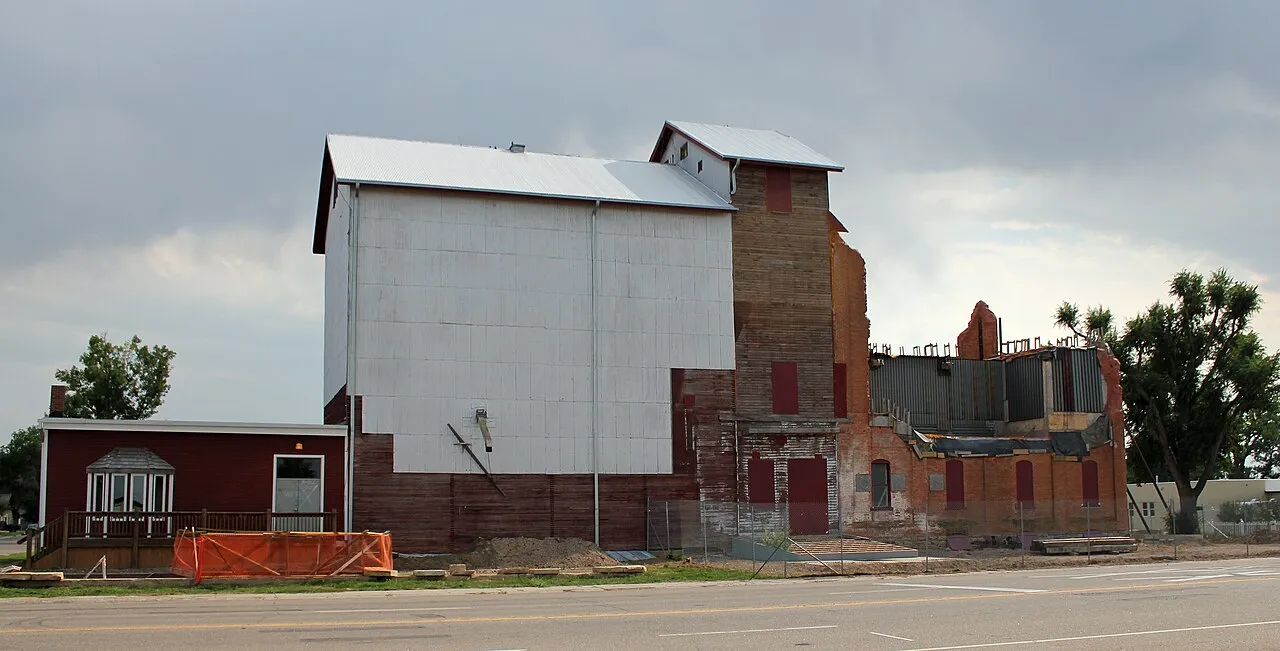
The mill’s story did not end with the tornado. Listed on the National Register of Historic Places and named one of Colorado’s Most Endangered Places in 2002, it was sold in 2015 to owners who put more than $3 million into rehabilitating it, with the Town offering up to $3 million in incentives, before an early-morning fire in August 2017 all but destroyed it. The cause was found to be arson. The owners rebuilt it as a mixed-use project in the shape of the old one, keeping what could be kept, and today 301 Main Street holds the taproom of Peculier Ales and an event center. The photograph above shows the elevator and the brick mill in August 2012, between the tornado and the sale.
The town that doubled
Windsor’s old town hall became the Art & Heritage Center, with two free galleries, after the police and the fire department moved out, and the town around it kept growing: the Town’s own history calls the growth since 2000 unprecedented. The census counted 18,644 people in 2010 and 32,716 in 2020, and the Town’s 2026 community profile puts the figure at 48,302 across about 27 square miles, which stretch over the Larimer County line on the west. The Community Recreation Center on 11th Street marked its tenth birthday in October 2026; a weekday commuter bus, the Poudre Express, links the town to Greeley and Fort Collins; and in June 2026 the last gap in the 45-mile Poudre River Trail, between Timnath and Windsor, was closed. The lake in the middle of town, the beet shack and the depot in the park, and the mill on Main Street are the sugar town’s remaining furniture.
Sources
- Windsor, Colorado on Wikipedia: the 1873 half-way house, the 1882 platting, the name, the 1890 incorporation, the 1903 factory, the mid-1960s closure, Kodak, the two counties, home rule and the 2010 and 2020 censuses.
- Windsor History, Town of Windsor: the Halfway House, the 1882 railroad, the 1905 to 1966 factory years, the German-Russian community, telephone in 1893, electricity in 1909, the hospital, opera house and town hall, the Kodak plant and the growth since 2000.
- Demographics, Town of Windsor: the 2026 community profile’s 48,302 residents and 27 square miles.
- Art & Heritage Center, Windsor History Museum and Historic Halfway Homestead, Windsor Parks, Recreation & Culture: the 1909 town hall’s police, jail and fire station, its 2008 restoration, the depot, schoolhouse and beet shack, and the Halfway House and 1907 farmhouse.
- Windsor Town Hall, National Park Service: the 1999 National Register listing, the Felmlees and the Classical Revival style.
- Windsor Mill, Colorado Preservation, Inc.: the 1899 building, flour and feed until 1990, the 2002 endangered listing, the 2008 tornado, the 2015 sale, the 2017 fire and arson finding, and the rebuilding.
- Great Western Sugar Company on Wikipedia: the Windsor factory’s 1903 construction, 1905 acquisition, 1919 capacity, 1968 closure and Kodak’s use of the site.
- KUNC, March 26, 2024: Kodak’s 3,500 workers, Carestream’s 2007 sale and 2024 closure, and Kodak Alaris.
- The May 22, 2008 Windsor tornado, National Weather Service Boulder: the time, path, rating, winds, death, injuries, homes and insured losses.
- AI Data Center Project Information, Town of Windsor: the Global AI proposal on the former Kodak and Carestream campus.
- Poudre River Trail, Larimer County: the 45 miles and the June 2026 completion.
- Peculier Ales: the taproom at 301 Main Street.